

Family Law in South Carolina:
A Comprehensive Overview
What You Will Learn
-
What the Family Court can decide—and how your case moves forward
-
How divorce and separation choices can affect your rights and finances
-
How custody and child support decisions impact your children and parenting time
-
How property, debt, and alimony decisions shape long-term financial stability
Family Law In South Carolina
South Carolina family law attorney guidance is often needed when family law matters arise during periods of profound personal change. Divorce, custody disputes, support issues, and property division are not only legal events—they are decisions that shape family relationships, financial stability, and daily life long after a case concludes. Because of this, understanding how family law works in South Carolina is critical before taking action.
This page provides a comprehensive overview of South Carolina family law, the issues most commonly addressed by the Family Court, the legal standards applied by judges, and the processes that typically govern these cases. It is designed to help individuals understand the legal framework in which family law decisions are made, rather than to provide legal advice for any specific situation.
The Scope of Family Law In South Carolina
Family law in South Carolina governs legal relationships between spouses, former spouses, parents, children, and other family members. These matters are handled exclusively in the South Carolina Family Court system, which has jurisdiction over issues including:
- Divorce and legal separation
- Separate support and maintenance
- Child custody and visitation
- Child support
- Alimony (spousal support)
- Equitable division of marital property and debt
- Enforcement and modification of prior court orders
While these categories are often discussed separately, they are frequently interconnected. Decisions in one area—such as custody or fault grounds for divorce—can directly affect outcomes in others, including support and property division.
- Read the South Carolina Children's Code
Divorce And Legal Separation
Grounds for Divorce
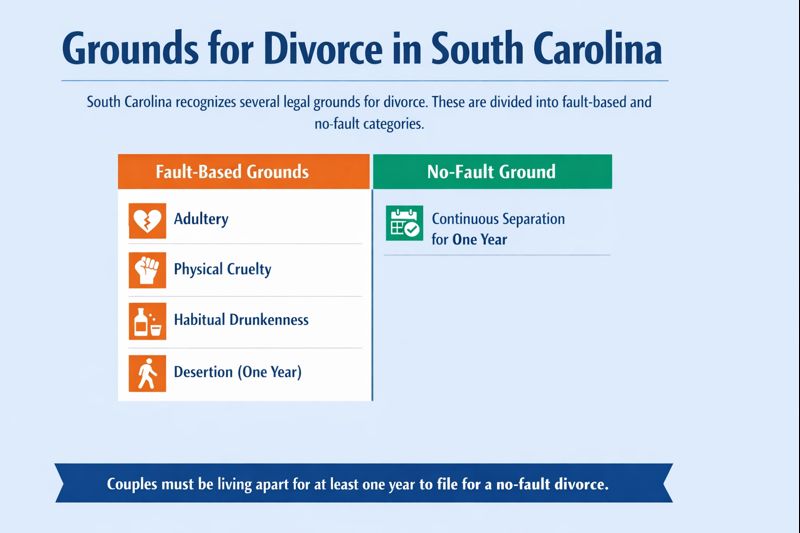
South Carolina recognizes both fault-based and no-fault divorce.
Fault grounds include adultery, physical cruelty, habitual intoxication, and desertion. A no-fault divorce requires the parties to live separate and apart without cohabitation for the required statutory period.
The choice between fault and no-fault divorce can have meaningful legal consequences. Fault may affect eligibility for alimony, influence credibility assessments, and shape litigation strategy. No-fault divorce, while often less adversarial, requires patience and compliance with separation requirements.
In some cases, parties pursue separate support and maintenance rather than immediate divorce. This allows the court to address custody, support, and financial matters while the marriage remains legally intact.
- Learn more about: Divorce & Separation
Child Custody and Vitiation
Legal and Physical Custody
Custody determinations in South Carolina involve two distinct concepts:
- Legal custody, which concerns decision-making authority over matters such as education, healthcare, and religious upbringing
- Physical custody, which determines where a child resides and how parenting time is allocated
Custody may be sole or joint, depending on the circumstances.
The Best Interests of the Child Standard
South Carolina courts decide custody issues based on the best interests of the child. This standard requires judges to evaluate a wide range of factors, including:
- Each parent’s involvement in caregiving
- The child’s developmental and emotional needs
- Stability of each household
- The ability of each parent to foster a healthy relationship with the other parent
- Any history of abuse, neglect, or substance use
No single factor is determinative. Courts assess the totality of the circumstances rather than applying a formula.
Guardians ad Litem
In contested custody cases, the court may appoint a guardian ad litem to investigate and make recommendations regarding the child’s best interests. Their role, while influential, is advisory rather than binding.
- Learn more about: Child Custody & Vistation
Child Support
Child support is intended to ensure that children receive consistent financial support from both parents. South Carolina uses statutory Child Support Guidelines that take into account:
- Gross income of both parents
- Childcare expenses
- Health insurance and uncovered medical costs
- Number of children and custodial arrangements
While guideline calculations provide a starting point, courts may deviate when circumstances justify a different result. Support obligations may be established in an initial proceeding or modified later if there is a substantial change in circumstances.
Enforcement mechanisms are available when support obligations are not met, but modifications require court approval.
- Learn more about: Child Support
Alimony (Spousal Support)
Types of Alimony
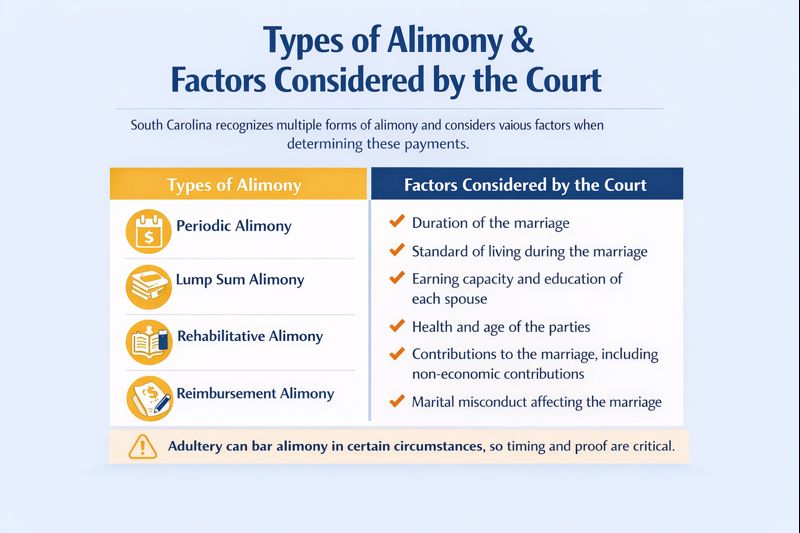
South Carolina recognizes multiple forms of alimony, including periodic, lump sum, rehabilitative, and reimbursement alimony. Each serves a different purpose and is appropriate in different factual contexts.
Factors Considered by the Court
Alimony is not automatic. Courts evaluate statutory factors such as:
- Duration of the marriage
- Standard of living during the marriage
- Earning capacity and education of each spouse
- Health and age of the parties
- Contributions to the marriage, including non-economic contributions
- Marital misconduct affecting the marriage
Adultery can serve as an absolute bar to alimony under certain circumstances, making timing and proof issues particularly important.
- Learn more about: Alimony & Support
Division of Marital Property and Debt
South Carolina follows the principle of equitable distribution, which means marital assets and debts are divided fairly, though not necessarily equally.
Marital vs. Non-Marital Property
The court must first classify property as marital or non-marital before determining how it should be divided. This process often involves tracing assets, evaluating commingling, and assessing contributions over time.
Factors in Equitable Distribution
Courts consider numerous factors, including:
- Length of the marriage
- Contributions of each spouse
- Income and earning potential
- Marital misconduct
- Tax consequences
Property division decisions can significantly affect long-term financial stability, making accurate valuation and classification essential.
- Learn more about: Property & Debt Division
Temporary Orders and Final Resolutions
Many family law cases involve temporary hearings early in the process to establish interim rules regarding custody, support, and financial responsibilities. While temporary, these orders often set the tone for the remainder of the case and may influence final outcomes.
Final resolutions may occur through negotiated agreements, mediation, or trial. Settlement is common, but not every case is appropriate for resolution without court intervention.
Understanding the distinction between temporary and final orders helps manage expectations and reduces uncertainty during litigation.
Mediation, Settlement, and Trial
South Carolina family courts encourage resolution through negotiation and mediation when appropriate. Mediation allows parties to retain control over outcomes and often reduces emotional and financial costs.
When settlement is not possible, the court will resolve disputed issues at trial. Judges apply statutory standards and exercise discretion based on the evidence presented.
Common Misconceptions About Family Law
Many individuals enter family court with assumptions that do not reflect how the law actually works. For example:
- Custody is not automatically awarded based on gender
- Property is not automatically divided 50/50
- Alimony is not guaranteed based solely on length of marriage
- Verbal agreements regarding support are not enforceable without court approval
Understanding these realities early can prevent costly mistakes.
When Legal Guidance May Be Appropriate
Family law issues often involve overlapping legal, financial, and emotional considerations. Even when matters appear straightforward, understanding rights, obligations, and long-term consequences is important before decisions are finalized.
If you are facing a family law issue in South Carolina and would like guidance tailored to your circumstances, speaking with an attorney can help clarify your options and next steps.

A Thoughtful Approach to Legal Decisions
Legal issues involving family, property, or long-term planning are rarely just legal problems. They affect people, relationships, and the stability of life moving forward. At our firm, we believe effective legal guidance begins with listening, understanding context, and focusing on solutions that serve you not only today, but over time.
If you would like to discuss your situation and understand your options, we invite you to schedule a confidential consultation.
Schedule a consultation
Submitting this form does not create an attorney-client relationship. Please don't include confidential details until we've spoken with you. For urgent matters, call (843) 488-5600.